Showing posts with label Phacelia. Show all posts

Tuesday, April 12, 2016

I love spring

On the road

My commute home from work site--skirting the storm.
 It's so great to see the hills all green after years of drought.
Check out how the rainbow is doubling itself (at the bottom).

One of the cutest things I've EVER seen: baby killdeer
with its siblings and very busy parents at Merced National Wildlife Refuge.
Check out that TINY wing! =)

Snow goose, also at the Merced NWR.
That beak makes me think of a sock puppet, for some reason... =)


This native phlox was SO frothy & pink (on highway 166) we HAD to pull over
during our drive to Carrizo Plain NM.

The Carrizo Plain NM: a fascinating place.
Heaven for a minimalist, and I was anxious to visit, since
the last time we saw it, it was 4 years into a drought.
 Soda Lake stirred by wind.

Carrizo Plain had greened up nicely, thanks to El Niño.

Desert candle (Caulanthus inflatus), a species I'd never seen before, at Carrizo Plain NM.
Another thing we saw from the car & stopped to investigate. =)

We drove up elevation from Carrizo & found purple puddles of Phacelia. So great!


Closer shot of Phacelia--love those flamboyant anthers. =)

More wildflower puddles, north and uphill of the Carrizo Plain.


Back home

Band-tailed pigeons appeared under our bird feeder—that was a first!
They are SO much bigger than mourning doves (upper left corner).
Love their bright beaks & feet.

Ladybird beetle upon lilac. Ah, spring! =)

 The new climbing rose we just bought is making me swoon.
 I have a thing for anthers...

Wavyleaf soap plant (Chlorogalum pomeridianum) beading water beautifully. =)


Lovely variegated miner's lettuce (Claytonia spp.) on our property that caught my eye.
So stylish! =)

Last, a wild hyacinth (Dichelostemma capitatum) on our property.
What an elegant beauty.

I hope you all are having a marvelous spring (or fall).
It's a pretty amazing thing.

xoxoxobb

Tuesday, April 20, 2010

Fire? What fire? ...uh, where'd everybody go?


So sayeth the Yucca whipplei at the Station Fire, which burned last year. It was the giant fire near Los Angeles that burned and burned and burned. Huge.


It's very clear from driving in the area that this was one of those just-get-out-of-its-way fires. SO steep out there, SO dry (even in April after a wet winter).

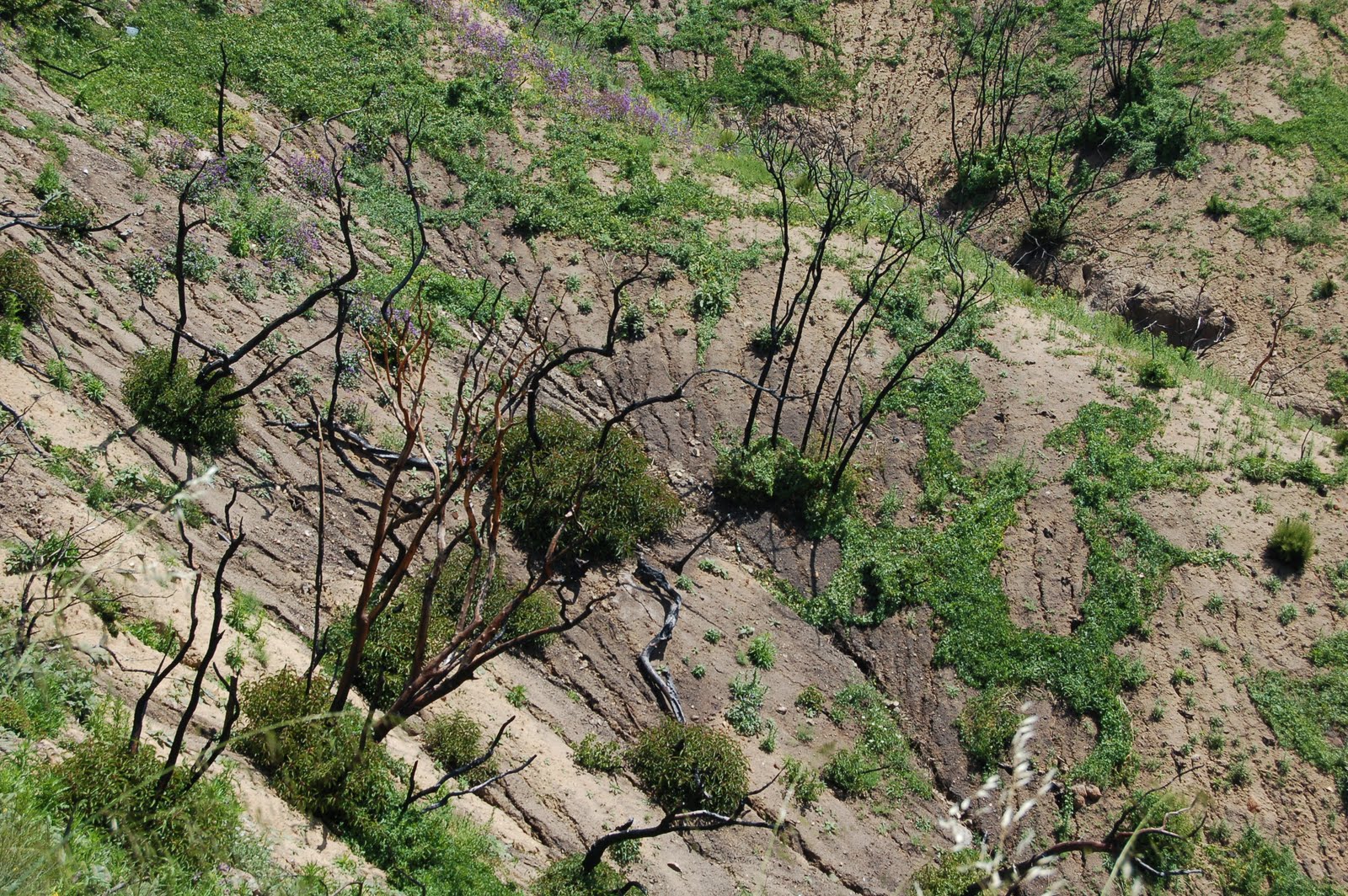
However, the vegetation is very much coming back--at least some of it, in some areas.


Check out all the tiny rivulets formed by the rain washing down the hillside. I'm guessing that's because of the over- and understory being pretty much gone, and the hydrophobic nature of crispy hillsides. It's a cool visual effect, although it indicates erosion. Plants are busily re-sprouting (puff of green at the base).

The yucca, like charred pineapples, dot the spare hillsides. And many were blooming, sending up what look like the biggest asparagus spears you've ever seen.


Is this where pink elephants get their trunks?

Possibly my favorite photo of the day. Y. whipplei firing on all cylinders:


Here's a close up of the Y. whipplei flowers, amazing photo courtesy of Noah Elhardt who generously gave it to the public at large.

And can you guess what area did burn, and which did not?


For some plants, there's nothing they love more than a good blaze. Some require it to reproduce. Some just benefit from the additional light, decreased competition (cleared over and understory), the fresh deposit of ash, etc.

There were several species out there this weekend doing GREAT, thank you very much. STUNNING display in places.

This, I believe, is Phacelia minor, a.k.a. wild Canterbury bells. Thanks to the friendly stranger who was there, for pointing me in the right direction, and thanks to the Regional Flora of Santa Monica Mountains (they're nearby) for getting it down to species.


One picture of this Phacelia that I found on the web had a conspicuously charred shrub branch right next to it, dated 1996. Guess it's followed fire before? =)

This looks to me like Mimulus brevipes, wide-throated yellow monkey flower. Screaming color, especially piercing over the purple Phacelia.


These scenes, versus the wildflowers, were a larger percentage of the landscape. Being a minimalist, I loved it.


So much spare, striking beauty after an inferno.

Reminds me of a friend who's house burned to the ground a few summers ago when Mariposa county had a serious conflagration. Her animals were rescued, but she basically ended up with the clothes on her back. There had been a stout tree in their front yard, and even the stump was gone. Just ash.

She told me, months later, whispering like a criminal, it was kind of a good thing. No baggage. No huge weight of THINGS that you own and lug with you wherever you move (if all the stuff didn't mentally prevent you from moving!). No mortgage. Of course, everything she was wearing had been donated (and sort of looked it), but she didn't care.

The fire-induced spareness brought a lightness to her being.* She was really grateful, and felt freed.

Just like the post-fire plants. Basking in the elbow room, the uninhibited sunshine, and the crinkly soil.

They are all the better for it.

biobabbler

*Thank you Milan Kundera

Monday, March 22, 2010

homework for a biologist - Q&D flowering plant i.d.

          
From the hike I took yesterday are, as usual, many unanswered questions. Most of which are "what is this plant?" So, here's a look at a few of the plants I got shots of, but was not certain re: it's name (common or scientific), or where I learned something about it today that I did not know yesterday.

Caveat: these names are my best guesses, based upon readily available references and these photos, and not from having the specimen in hand and our field scope out of storage (where it sadly waits for us) and Jepson's guiding me at every step in keying out. This is the quick and dirty (Q&D) version.

1st, candidate for most adorable. SO tiny. The whole thing is about two inches tall. A Lilliputian masterpiece.


I am basically in love with this plant. Linanthus bicolor is the scientific name, true baby stars and Linanthus are two of the common names (www.calflora.org). Another common name listed is bicolor linanthus, but if the scientific name is Linanthus bicolor, I don't think that common name adds much, do you?

Here's one I learned last year and since forgot, but looked up again and, voila, caterpillar phacelia (Phacelia cicutaria):


It's a flower you can readily overlook as there are SO many other, much brighter white flowers, not to mention the purple, orange, yellow and pink ones. But it is a cool bloom, especially when you stop and look at it more closely.

Now, on to goldfields, which are painting the foothills right now (hence their name).


Now, a closer look:


This particular goldfield is sporting what I assume is a crab spider (family Thomisidae), specifically a flower crab spider (genus Misumena). SO cute. I love crab spiders and how they love to hang out on flowers. Charming trait.

Of course, once I think about it again, what better place to lurk than a flower, which SO many species are drawn to for sustenance... cute? Hm... maybe not so much. Efficient, yes.

Many blog entries ago I put up a picture of a spider doing a very good job of NOT looking like a spider. Pretty sure it's also a crab spider.

BTW Thank you bugguide.net, AGAIN. Check out this amazing picture... http://bugguide.net/node/view/67374/bgpage  Those are some fierce, stylish spiders.

Alright, that's all for now. More soon. Rest of day/life beckons... but so psyched about the additional photos I have to fling at you! And a tiny butterfly let me get SO CLOSE I was amazed...

xobiobabbler

P.S. Anyone else out there nuts about spring? LOVE it so much.