Showing posts with label plants. Show all posts

Tuesday, January 5, 2016

life, art, biology, repeat: quick East Coast flash, bug question & a question answered


During our trip back east,
I pigged out at the National Gallery of Art in Washington, DC.
So yum.

What follows: a biological subset of the delicious repast.

Images Caveat
I looked for but didn't find "can't share these" on nga.gov,
I only took photos of those we were allowed to (w/o flash, of course),
& given that many can be downloaded for free here,
& many are >100 y.o., I'm thinking it's ok to share them here. =)
End Caveat

Gorgeous data bank

Painting style that makes the nature noodle in me drool...
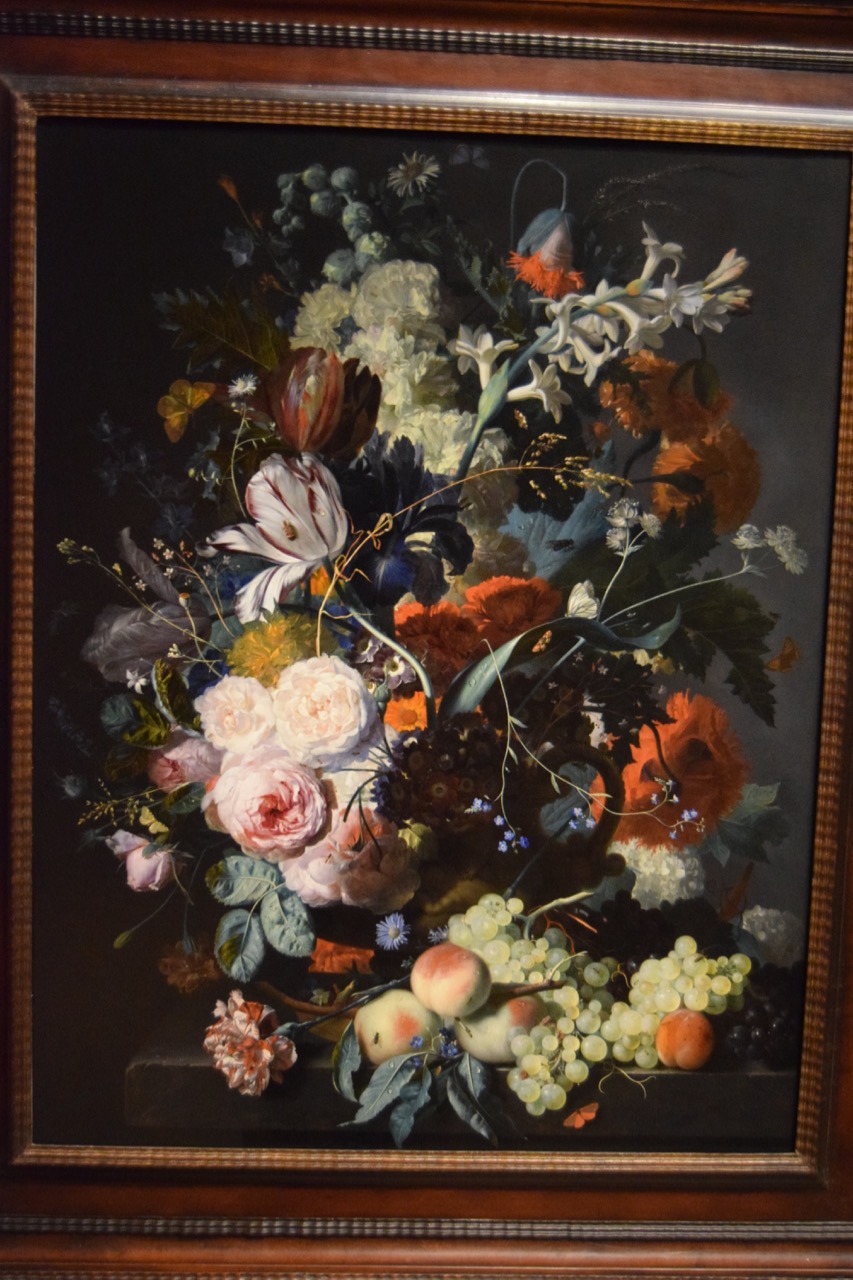
Still Life with Flowers and Fruit
Jan Van Huysum, oil on panel, circa 1715, Dutch

Stunning, excruciatingly detailed work that seems like a
great way to preserve data re: living things (if accurate).

Can't imagine any pressed botanical specimen
having color like after 200 years
(tho' obviously natural history museum collections
can be staggeringly valuable to science).

Seems like you could ID many of these species,
if you knew where they were collected. Maybe. =)

And the bugs are the kicker.
Detail of Still Life with Flowers and Fruit

I bet $$ that's a (300 yr old) tiger beetle. =)

Can any bug people confirm or deny my tiger beetle guess?
Pretty please do, in comments, below. I'd be MOST grateful. =)

Fly, ants & butterfly (or moth?), same painting:

I think it'd be fun to review the flora and fauna
of paintings like these to see if they were accurately depicted.


Not your "Great British Bake Off"...
Still Life with Peacock Pie
Pieter Claesz
oil on panel, 1627, Dutch

This made me think of the amazing creations
that Great British Bake Off contestants try to emulate.

But, the first thing I thought of
when I saw the above was the Migratory Bird Treaty Act. =)
I'm pretty sure peacocks aren't covered by it (not native to US, etc.),
but part of my job is to look for such violations, so my brain sent up a RED FLAG. =)

Also, by now the bird's been dead for close to 400 years...


Among NGA's amazing display of lush American-made furniture,
this table leg caught my eye, for obvious reasons. =) 
RAWR! =)


I'll post more images & thoughts later,
but for now, I'll address what many have asked:

Why don't you spend more time at the Natural History Museum?

Because that stuff is what I've been studying
my WHOLE LIFE (or there abouts).

I want to look at different things,
unfamiliar things,
things I may not understand.

I want to explore other worlds when I'm on vacay.

And, apparently, art makes me happy.

Really happy.

=)

Plus, there's LOADS of overlap between nature and art
which I'll continue to explore in further posts.

And I believe nature can explain much of why that overlap exists.

We're just another mammal, after all.

=) 

xoxoxobb


Sunday, January 12, 2014

Wednesday, December 25, 2013

There's magic in the air...

…and possibly in these pouches packed with promise. 


Ills they are alleged to address:
anemia, gastritis, gall bladder problems, ovary issues,
menopause, lung ailments, gout, lagging circulation,
liver troubles, unhappy colons,
and, of course, cancer.

I certainly hope it is true.
Given all the things plant compounds can do for and to us,
there's certainly plenty of potential.


It's so surprising when you learn of non-human animals
using plants to aid themselves (other than eating them),
like rats who line their nests with rosemary.
Rats with rosemary-festooned nests have fewer fleas
than rats that eschew the pungent herb.

That is how I learned to decorate the coop w/rosemary.
Which means I learned it from rats.

I hope the rats out there know, somehow,
that their botanical knowhow is responsible for my happy hens.

Might not be magic, but it's pretty amazing to me.

xoxobb

Thursday, December 5, 2013

Day 4: Natural Light


Variegated lighting on my variegated sage = happiness.

Then, one that didn't work as well, but in person is WAY amazing:
rainbows on frozen grasses (24 F) this a.m.
Ya really need to zoom in on it, but wow.


It's really one of those things where if you DON'T go out when it's FRICKIN' FREEZING,
you'll miss it entirely.

And THAT is some natural light that totally rocks my (wool) socks.

Day 4 of 30 Day Challenge = DONE.

Tomorrow's assignment = Friend

xoxoxobb

Friday, March 1, 2013

this yucca is a siren: alluring and hazardous


 This plant is killing me about eight different ways, right now.

(zoom way in--the blossoms are amazing)

All I can do is ogle and shoot.


Tiny peeks at large flowers through layers of yucca swords.

The ultimate flirt.

From hundreds of square miles of parched, scratchy scrub,
in a singularly shade-free landscape,
spring these succulent, glistening flowers,
glowing high, out of reach,
a calm center in a whorl of yucca swords.

This plant is a siren.

The yucca I know (Yucca schidigera, in California) has an anti-coagulant in it,
which I learned the first (and last) time
I was careless enough to get stabbed by one.

In the micro second between getting stabbed in the hand,
and looking at my wound,
a thick stream of blood had already flowed to my wrist.

Got my attention.

If the yucca in Big Bend NP are at all like those at home,
not only might most sad, parched little land animals
never get to the flowers,
but they may bleed to death at her feet for their efforts.

Sirens don't show mercy.
Yuccas don't weep for thirsty mammals.
Sirens and yuccas need what they need,
and if you are not it,
 best just accept it and move on.

It's not about you.

xoxobb

Tuesday, April 19, 2011

absinthe, Degas, death, & petting bird poop: vocab quiz answer

(fyi to navigate this TOME, bold = sub-title topics)

As a reminder, the phrase in my head while waking up Saturday a.m. was: Foeniculum vulgare. Over and over and over.

Had no idea what it was, aside from a scientific name, and probably a plant; thus the quiz.

Let's review the delightful guesses...

Cindy said...
smelly rangy thang? I know the plant is wild fennel but never thought about the Latin derivation. I will resist looking up to wait for your own particular biobab presentation of the facts.

Patricia Lichen said...
Clearly, Foeniculum vulgare is Latin for those people who hold loud cellular phone discussions about their romantic conquests.

MObugs said...
noxious, vulgar shrubs for those people who are partial to smelly, toxic, unpleasant greenery?

mainly mongoose (Lynda) said...
Foeniculum vulgare is a small bony protuberance which develops on the index finger due to excessive belligerent gesturing.

*sigh*

Do you see why I love these people? =) So creative and funny.

First, I hereby declare ALL of these guesses 100% correct in Biobabbler-ville. Excellent work!

Foeniculum vulgare, a.k.a. fennel.

Next, yes, as Cindy said, F.v.'s common names include fennel and anise; if you've brushed against it, you probably smelled black licorice.

Through the years resource managers removed fennel from
Cabrillo National Monument. At least, I think it's still gone...

Now, lets get Wikilicious:

"Fennel (Foeniculum vulgare) is a plant species in the genus Foeniculum... It is a member of the family Apiaceae. It is a hardy, perennial... herb, with yellow flowers and feathery leaves. It is generally considered indigenous to the shores of the Mediterranean, but has become widely naturalised in many parts of the world, especially on dry soils near the sea-coast and on river-banks."

That last bb-italicized part means, again "will pester biobabbler's beloved coastal sage scrub (CSS)."

Coastal southern California has a Mediterranean climate (check out the map on that link, very limited areas, but many of them swap species...). Pretty much anything indigenous to the shores of the Med has a better-than-random chance of making it on the soCal coast.

*******
Here's a quiz within-a-quiz-answer: Based on how the author spelled "naturalised" where might this person be from (assuming they are a skilled speller)? 
*******

Calflora pulls no punches:
"...Is a perennial herb that is not native to California; it was introduced from elsewhere and naturalized in the wild.

" The California Invasive Plant Council (Cal-IPC) lists plants that cause serious problems in native ecosystems... [and] classifies the statewide impact [of F.v.] as high."

"It can drastically alter the composition and structure of many plant communities, including grasslands, coastal scrub, riparian, and wetland communities." (Cal-IPC)

death

Translation: biobabbler learned while baby ranger
that this is a "bad plant."

Initially my NPS-vegetation-world-view was made up of 2 categories:

native = good
non-native = bad

This fork in the logic tree led to two different actions:

good => protect and/or propagate
bad =>  kill

So, fennel = non-native = bad = I got to kill it.

I was obliged to kill it.

bb-as-lethal-weapon*

It was my duty to remove this scourge in order to protect CSS.

And being a conservation biology dork, NPS mission believer, and a rather high energy 22-year-old, this translated into:

Kill Kill Kill!

Alternatively (and botanically loosely**) billed as:

Kill Dill!

(picture credit listed as Thomas, but I kinda doubt he's the original.
Lemmeno if this is yours and how I might credit it [if I may still use it].)

absinthe

Foeniculum vulgare "...is a highly aromatic and flavorful herb with culinary and medicinal uses, and is one of the primary ingredients of absinthe." (Wiki)

Degas

Now that brings to mind the lovely L'Absinthe (Degas 1876)

This is where I got this image.***

Love this painting.

I think it very effectively conveys a seldom-portrayed mood.

And, is not unlike biobabbler-at-low-blood-sugar
(if she's also unusually well dressed at the time).

Kinda absent. 

Absinthe minded.

Absinthe has experienced a renaissance, of late (biobabbler does listen to food shows), being made in a few countries, but mostly minus it's narcotic effects which, according to Wiki, had been exaggerated.

called La Muse Verte (the green muse, a.k.a. absinthe).
Never seen this before and totally smitten. LOVE IT.

The name absinthe comes from the specific name of the main plant usually used to make this drink, Artemesia absinthium (a.k.a. wormwood).****

Back to the quiz: Foeniculum is apparently Latin for fennel and

"In Ancient Greek, fennel was called marathon (μάραθον)... John Chadwick noted this word is the origin of the place name Marathon (meaning "place of fennel")" (Wiki)

Now, this link to the word marathon, was TOTALLY unexpected. Fennel Place. Who knew?


From etymonline.com it appears that vulgare = common. Interesting tidbits from there:
Vulgate Look up Vulgate at Dictionary.com
c.1600, Latin translation of the Bible [bb emphasis], especially that completed in 405 by St. Jerome (c.340-420), from M.L. Vulgata, from L.L. vulgata "common, general, ordinary, popular" (in vulgata editio "popular edition"), from L. vulgata, fem. pp. of vulgare "make common or public," from vulgus "the common people" (see vulgar). So called because the translations made the book accessible to the common people of ancient Rome.
divulge Look up divulge at Dictionary.com
mid-15c., from L. divulgare "publish, make common," from dis- "apart" (see dis-) + vulgare "make common property," from vulgus "common people" (see vulgar). Related: Divulged; divulging.

petting bird poop

"Fennel is used as a food plant by the larvae of some Lepidoptera species including the mouse moth and the anise swallowtail." (Wiki)

This brings to mind a tale. Specifically, an anise swallowtail tale.

When I lived in San Diego, there were Foeniculum vulgare plants bursting through the sidewalk cracks in our back alley, so we passed them every time we ventured toward the trash or recycling bins.

My friend Dan (Rubinoff, a.k.a. Moth Man), helped us (my landlady and her family and I) notice the the anise swallowtail larvae that lived there and that would eventually become those large, gorgeous butterflies we'd see flitting about my landlady's lovely garden (which was my front yard, lucky me).


So, having learned what their larvae look like...

 This is a black swallowtail butterfly larva, 1st instar 

... I was searching the anise plant one day, hoping to find one of these little cuties. Well, apparently they have evolved to resemble bird droppings.

And you'd think, "I'm not going to confuse them, silly! I'm not some dopey bird..."

Well, I reached out to touch what I thought was a tiny, adorable caterpillar, and it mooshed onto my finger.

ew.

Bird poop.

Wow.

Color me a little grossed out, and very impressed that those little tiny bugs got me (you know, Homo smartypants) to try and pet bird poop 'cause I thought it was a baby butterfly.


Well, I guess if in biology you wanna learn, you're likely to get a little dirty, now and then.

However, sometimes, like today, we can also get a little artsy. Now and then.

And to think all I set out to learn was what Foeniculum vulgare meant.

Thank you, brain! (you little badgering vocabulary hoarder)


And thank you biobabbler readers for motivating me to wander down these pathways, exploring the world, feeding the gray matter. Very much present, thank you very much.

Great fun.

=)

xobiobabbler


*bb re-enacting 4th grade door-busting-episode wherein bb imitated (all too well) the bionic woman or wonder woman and during a flying leap, pretending to break down the door (to retrieve a 4 square ball, I think?), her foot actually went through that very door. Oops.

**You know, the Quentin Tarentino film? I liked Kill Bill II best, but how could I not love a film with a super ass-kicking 6 foot tall blond heroine?? But I digress... oh, and check the link on "botanically loosely" as dill and fennel are not the same spp. but are quite similar.

***"This media file is in the public domain in the United States. This applies to U.S. works where the copyright has expired, often because its first publication occurred prior to January 1, 1923. See this page for further explanation."

****(btw Artemesia californica , California sagebrush, is a key component of coastal sage scrub.)