Showing posts with label art. Show all posts

Tuesday, January 5, 2016

life, art, biology, repeat: quick East Coast flash, bug question & a question answered


During our trip back east,
I pigged out at the National Gallery of Art in Washington, DC.
So yum.

What follows: a biological subset of the delicious repast.

Images Caveat
I looked for but didn't find "can't share these" on nga.gov,
I only took photos of those we were allowed to (w/o flash, of course),
& given that many can be downloaded for free here,
& many are >100 y.o., I'm thinking it's ok to share them here. =)
End Caveat

Gorgeous data bank

Painting style that makes the nature noodle in me drool...
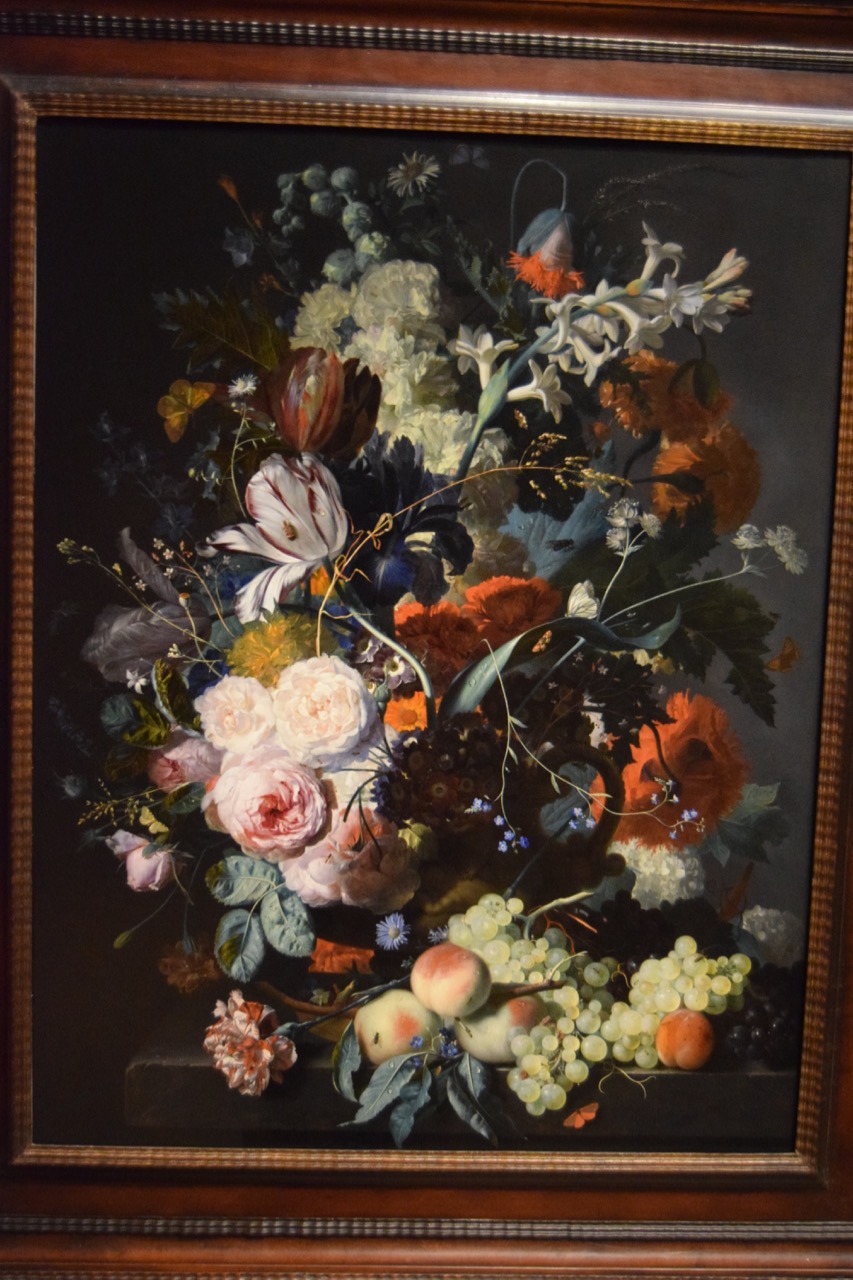
Still Life with Flowers and Fruit
Jan Van Huysum, oil on panel, circa 1715, Dutch

Stunning, excruciatingly detailed work that seems like a
great way to preserve data re: living things (if accurate).

Can't imagine any pressed botanical specimen
having color like after 200 years
(tho' obviously natural history museum collections
can be staggeringly valuable to science).

Seems like you could ID many of these species,
if you knew where they were collected. Maybe. =)

And the bugs are the kicker.
Detail of Still Life with Flowers and Fruit

I bet $$ that's a (300 yr old) tiger beetle. =)

Can any bug people confirm or deny my tiger beetle guess?
Pretty please do, in comments, below. I'd be MOST grateful. =)

Fly, ants & butterfly (or moth?), same painting:

I think it'd be fun to review the flora and fauna
of paintings like these to see if they were accurately depicted.


Not your "Great British Bake Off"...
Still Life with Peacock Pie
Pieter Claesz
oil on panel, 1627, Dutch

This made me think of the amazing creations
that Great British Bake Off contestants try to emulate.

But, the first thing I thought of
when I saw the above was the Migratory Bird Treaty Act. =)
I'm pretty sure peacocks aren't covered by it (not native to US, etc.),
but part of my job is to look for such violations, so my brain sent up a RED FLAG. =)

Also, by now the bird's been dead for close to 400 years...


Among NGA's amazing display of lush American-made furniture,
this table leg caught my eye, for obvious reasons. =) 
RAWR! =)


I'll post more images & thoughts later,
but for now, I'll address what many have asked:

Why don't you spend more time at the Natural History Museum?

Because that stuff is what I've been studying
my WHOLE LIFE (or there abouts).

I want to look at different things,
unfamiliar things,
things I may not understand.

I want to explore other worlds when I'm on vacay.

And, apparently, art makes me happy.

Really happy.

=)

Plus, there's LOADS of overlap between nature and art
which I'll continue to explore in further posts.

And I believe nature can explain much of why that overlap exists.

We're just another mammal, after all.

=) 

xoxoxobb


Friday, November 2, 2012

pointillism, schmointillism: aspen art


nature's pointillism

When I was in high school I got into pointillism
when both my English and French classes
were in art history mode.

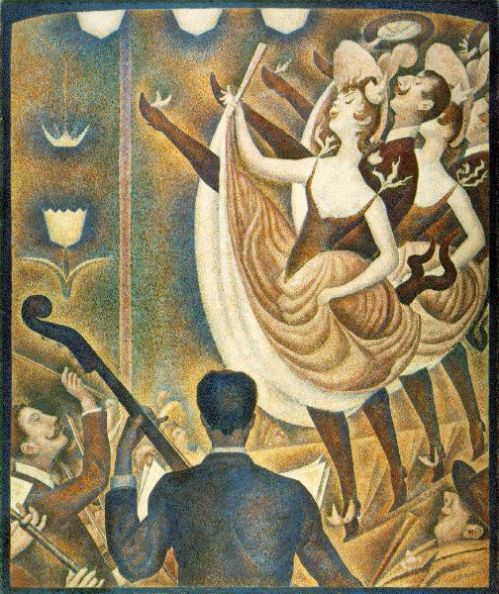
And, there was Georges Seurat,
painting in such a strange way.
It was weird. And beautiful.
And I couldn't stop staring.

Le Chahut (1889-1890) by Georges Seurat

Last weekend, pointillism was everywhere.


And I couldn't stop staring.

Of course, cameras cannot fully convey this experience.
Those trees shimmer.
Each tiny leaf wiggles to and fro,
in the faintest of breezes,
flashing brilliant colors this way and that.

*sigh*

And, the "shshshshsh" sound is amazing.

(like the Seurat detail shots in text books...)

We'd stopped near Lee Vining,
seeing umpteen trucks pulled over at a really nicely lit group of trees.
Thought it was a photography class.
Nope.

Just two dozen photographers very quietly staring at
and shooting this amazing phenomenon.

The power of that beauty yielded a respectful silence.
People tip-toed here and there,
breathing it all in,
grateful to witness such a glorious exhibition.

=)

xobb

Thursday, January 12, 2012

nature in art in nature in art...

 
"Mommy, why is that lady staring at the ceiling?"


Because it's really, really pretty.

In the National Gallery of Art,
there's plenty of beauty that is not hanging on a wall,
or perched on a pedestal, protected by plexiglass.

Some of it is photosynthesizing.

I took very few photographs while in the museum;
they were expressly allowed in one particular exhibit.
Most of the images that inspired me to photograph them involved nature, the outdoors.
Mind you, I love portraits. Of people. Love.

However, two artists had captured ocean scenes so perfectly,
I had to photograph them so I could learn more about their work.

This* is "A Quiet Day in Manchester" by Alfred Thompson Bricher (1837-1908)**


I read about Mr. Bricher, and he lived much of his life by the ocean; not surprising.
This next one is "The Stranded Ship" by Asher Brown Durand (1796-1886).


The green in these waves? So true and real. Awesome. I just stare at it.


The pull of the Pacific

When in the NPS, one of my jobs, and its associated walking commute,
allowed me to see the Pacific Ocean four hours a day, five days a week.

The first birds I had to identify as a professional biologist were shorebirds.

The first natural resource monitoring I did was of the rocky intertidal community.

I was born in a beach town.

I still remember walking on the beach with my dad when I was four,
plastic baggy in hand to store all the shells I'd collect.

So, I feel bonded to that big, cold, powerful thing.

Which might explain why, when these painters really captured the ocean,
it stopped me in my tracks.


Love at first sight

Back at the gallery, I turn a corner and BAM,
there is one of my favorite paintings of all time.
I was instantly smitten the moment I saw it (in a book in high school).
And it's never diminished.

I had no idea it was at the NGA.

To direct you to it (since it's still under copyright, via another site),
I had to look up its name (just now, after writing about the Pacific),
which I had not known at all.

"Wind from the sea."

uh...


that's freaky.

You can see it here (and click on it to see it larger).


Art is everywhere

Then, leaving the NGA, stepping out the doorway, I see this:


The beauty doesn't stop when you leave the gallery, and step into nature.

=)

It just keeps going.
Hence my giddy, swoony, continuing love for nature.
It's fairly magical, always inspiring,
and, like so many of the amazing DC museums, it's free.

xo
bb


*I did not straighten this photograph (via post-processing) because that'd reduce the clarity a lot.
**Public domain = 100 years after artist's death (says Wiki),
so these seascapes sail in that marvelous legal sharing space. =)

Friday, December 30, 2011

manly mammals

in art...


*sigh*

I heart art.

And Washington DC.

What an embarrassment of riches that town has.

Jeepers!

xo

ps. this is the 2nd time I've been on the internet in a week; blogging will still be slow for a while. However, am using camera here and there, so there may be more goodies for you upon my return to situation normal. I've posted pics of this uh-mah-zing statue before, but it bears repeating, IMHO.

Wednesday, May 4, 2011

Oh, fiddle dee dee. Amazing ball girl catch is neither...

 
Biobabbler was made a fool of, kinda.

This wonderful, evocative painting, "Stańczyk" by Jan Matejko, is alternately titled "Stańczyk during a Ball at the Court of Queen Bona after the Loss of Smolensk."*

I leaped before I looked.

On Facebook, I JUST posted a link to an article on how to check quotes & other Internet content for veracity. You know, pre-promulgation.

I figure this is especially important as I facebook and blog and tweet. Should get things straight.

So, bb checks out the article, and the first site they mention to check is snopes.com. So, I go. And I see the little twitter bird. "Oh, that'd be a good idea. Keep up with the latest sham-tastic thing." Good blogger.

Yeah, well, so the VERY 1st tweet I see is this:

"Video purportedly shows a ball girl making an amazing catch at a minor league baseball game. http://bit.ly/mStOq9"

Uh, "purportedly?"

Ruh roh....

Yup, FAKE! That video was a DRAFT commercial that did not get released, the "ball girl" is a professional stunt woman, and there were wires and big dudes off screen pulling on them involved.

Well, Crappity Mc.Crap-Crap.

NOT an amazing leap by some super athletic little ball girl.

However, after some mourning that it's not an amazing exhibition of Girl Power, I come to realize what it means.

Apparently leaps like this remain the purview
of ungulates and other wildlife,
not humans.

These incredible feats do happen.**
They can be witnessed.

Bighorn sheep at Grand Canyon NP (photo Marcin Wichary)


The amazing athletes just won't be wearing tennis shoes.


bb


*Allegedly, this painting implies that this jester, Stańczyk, a real person, btw, is the only attendee at a royal ball who is adversely affected by news that the Russians had wrested control of Smolensk from Lithuania (1514). According to Wiki, he "was the most famous court jester in Polish history. He was employed by three Polish kings: Alexander, Sigismund the Old and Sigismund Augustus." He is "remembered as a man of great intelligence and a political philosopher gifted with formidable insight into Poland's current and future situation. He used his job to criticize and warn his contemporaries by the use of satire." Brings to mind a certain modern day satirist.

** See 2nd hand account, from bb friend within the 1st ball girl post.

Tuesday, April 19, 2011

absinthe, Degas, death, & petting bird poop: vocab quiz answer

(fyi to navigate this TOME, bold = sub-title topics)

As a reminder, the phrase in my head while waking up Saturday a.m. was: Foeniculum vulgare. Over and over and over.

Had no idea what it was, aside from a scientific name, and probably a plant; thus the quiz.

Let's review the delightful guesses...

Cindy said...
smelly rangy thang? I know the plant is wild fennel but never thought about the Latin derivation. I will resist looking up to wait for your own particular biobab presentation of the facts.

Patricia Lichen said...
Clearly, Foeniculum vulgare is Latin for those people who hold loud cellular phone discussions about their romantic conquests.

MObugs said...
noxious, vulgar shrubs for those people who are partial to smelly, toxic, unpleasant greenery?

mainly mongoose (Lynda) said...
Foeniculum vulgare is a small bony protuberance which develops on the index finger due to excessive belligerent gesturing.

*sigh*

Do you see why I love these people? =) So creative and funny.

First, I hereby declare ALL of these guesses 100% correct in Biobabbler-ville. Excellent work!

Foeniculum vulgare, a.k.a. fennel.

Next, yes, as Cindy said, F.v.'s common names include fennel and anise; if you've brushed against it, you probably smelled black licorice.

Through the years resource managers removed fennel from
Cabrillo National Monument. At least, I think it's still gone...

Now, lets get Wikilicious:

"Fennel (Foeniculum vulgare) is a plant species in the genus Foeniculum... It is a member of the family Apiaceae. It is a hardy, perennial... herb, with yellow flowers and feathery leaves. It is generally considered indigenous to the shores of the Mediterranean, but has become widely naturalised in many parts of the world, especially on dry soils near the sea-coast and on river-banks."

That last bb-italicized part means, again "will pester biobabbler's beloved coastal sage scrub (CSS)."

Coastal southern California has a Mediterranean climate (check out the map on that link, very limited areas, but many of them swap species...). Pretty much anything indigenous to the shores of the Med has a better-than-random chance of making it on the soCal coast.

*******
Here's a quiz within-a-quiz-answer: Based on how the author spelled "naturalised" where might this person be from (assuming they are a skilled speller)? 
*******

Calflora pulls no punches:
"...Is a perennial herb that is not native to California; it was introduced from elsewhere and naturalized in the wild.

" The California Invasive Plant Council (Cal-IPC) lists plants that cause serious problems in native ecosystems... [and] classifies the statewide impact [of F.v.] as high."

"It can drastically alter the composition and structure of many plant communities, including grasslands, coastal scrub, riparian, and wetland communities." (Cal-IPC)

death

Translation: biobabbler learned while baby ranger
that this is a "bad plant."

Initially my NPS-vegetation-world-view was made up of 2 categories:

native = good
non-native = bad

This fork in the logic tree led to two different actions:

good => protect and/or propagate
bad =>  kill

So, fennel = non-native = bad = I got to kill it.

I was obliged to kill it.

bb-as-lethal-weapon*

It was my duty to remove this scourge in order to protect CSS.

And being a conservation biology dork, NPS mission believer, and a rather high energy 22-year-old, this translated into:

Kill Kill Kill!

Alternatively (and botanically loosely**) billed as:

Kill Dill!

(picture credit listed as Thomas, but I kinda doubt he's the original.
Lemmeno if this is yours and how I might credit it [if I may still use it].)

absinthe

Foeniculum vulgare "...is a highly aromatic and flavorful herb with culinary and medicinal uses, and is one of the primary ingredients of absinthe." (Wiki)

Degas

Now that brings to mind the lovely L'Absinthe (Degas 1876)

This is where I got this image.***

Love this painting.

I think it very effectively conveys a seldom-portrayed mood.

And, is not unlike biobabbler-at-low-blood-sugar
(if she's also unusually well dressed at the time).

Kinda absent. 

Absinthe minded.

Absinthe has experienced a renaissance, of late (biobabbler does listen to food shows), being made in a few countries, but mostly minus it's narcotic effects which, according to Wiki, had been exaggerated.

called La Muse Verte (the green muse, a.k.a. absinthe).
Never seen this before and totally smitten. LOVE IT.

The name absinthe comes from the specific name of the main plant usually used to make this drink, Artemesia absinthium (a.k.a. wormwood).****

Back to the quiz: Foeniculum is apparently Latin for fennel and

"In Ancient Greek, fennel was called marathon (μάραθον)... John Chadwick noted this word is the origin of the place name Marathon (meaning "place of fennel")" (Wiki)

Now, this link to the word marathon, was TOTALLY unexpected. Fennel Place. Who knew?


From etymonline.com it appears that vulgare = common. Interesting tidbits from there:
Vulgate Look up Vulgate at Dictionary.com
c.1600, Latin translation of the Bible [bb emphasis], especially that completed in 405 by St. Jerome (c.340-420), from M.L. Vulgata, from L.L. vulgata "common, general, ordinary, popular" (in vulgata editio "popular edition"), from L. vulgata, fem. pp. of vulgare "make common or public," from vulgus "the common people" (see vulgar). So called because the translations made the book accessible to the common people of ancient Rome.
divulge Look up divulge at Dictionary.com
mid-15c., from L. divulgare "publish, make common," from dis- "apart" (see dis-) + vulgare "make common property," from vulgus "common people" (see vulgar). Related: Divulged; divulging.

petting bird poop

"Fennel is used as a food plant by the larvae of some Lepidoptera species including the mouse moth and the anise swallowtail." (Wiki)

This brings to mind a tale. Specifically, an anise swallowtail tale.

When I lived in San Diego, there were Foeniculum vulgare plants bursting through the sidewalk cracks in our back alley, so we passed them every time we ventured toward the trash or recycling bins.

My friend Dan (Rubinoff, a.k.a. Moth Man), helped us (my landlady and her family and I) notice the the anise swallowtail larvae that lived there and that would eventually become those large, gorgeous butterflies we'd see flitting about my landlady's lovely garden (which was my front yard, lucky me).


So, having learned what their larvae look like...

 This is a black swallowtail butterfly larva, 1st instar 

... I was searching the anise plant one day, hoping to find one of these little cuties. Well, apparently they have evolved to resemble bird droppings.

And you'd think, "I'm not going to confuse them, silly! I'm not some dopey bird..."

Well, I reached out to touch what I thought was a tiny, adorable caterpillar, and it mooshed onto my finger.

ew.

Bird poop.

Wow.

Color me a little grossed out, and very impressed that those little tiny bugs got me (you know, Homo smartypants) to try and pet bird poop 'cause I thought it was a baby butterfly.


Well, I guess if in biology you wanna learn, you're likely to get a little dirty, now and then.

However, sometimes, like today, we can also get a little artsy. Now and then.

And to think all I set out to learn was what Foeniculum vulgare meant.

Thank you, brain! (you little badgering vocabulary hoarder)


And thank you biobabbler readers for motivating me to wander down these pathways, exploring the world, feeding the gray matter. Very much present, thank you very much.

Great fun.

=)

xobiobabbler


*bb re-enacting 4th grade door-busting-episode wherein bb imitated (all too well) the bionic woman or wonder woman and during a flying leap, pretending to break down the door (to retrieve a 4 square ball, I think?), her foot actually went through that very door. Oops.

**You know, the Quentin Tarentino film? I liked Kill Bill II best, but how could I not love a film with a super ass-kicking 6 foot tall blond heroine?? But I digress... oh, and check the link on "botanically loosely" as dill and fennel are not the same spp. but are quite similar.

***"This media file is in the public domain in the United States. This applies to U.S. works where the copyright has expired, often because its first publication occurred prior to January 1, 1923. See this page for further explanation."

****(btw Artemesia californica , California sagebrush, is a key component of coastal sage scrub.)